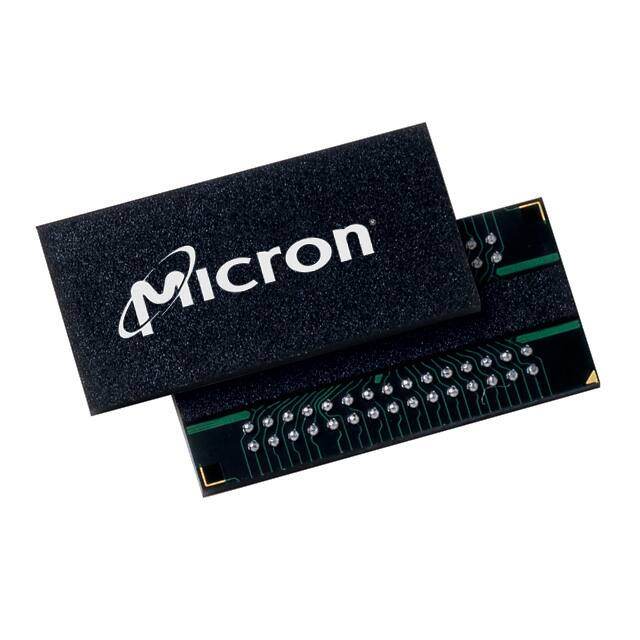
2Gb: x4, x8 TwinDie DDR2 SDRAM
Functionality
TwinDie™ DDR2 SDRAM
MT47H512M4 – 32 Meg x 4 x 8 Banks x 2 Ranks
MT47H256M8 – 16 Meg x 8 x 8 Banks x 2 Ranks
For the latest component data sheet, refer to Micron’s Web site: www.micron.com
Functionality
Options
The 2Gb (TwinDie™) DDR2 SDRAM uses Micron’s 1Gb
DDR2 monolithic die and, therefore, has similar functionality. This TwinDie data sheet is intended to provide a general description, package dimensions, and
the ballout only. Refer to the Micron 1Gb DDR2 data
sheet for complete information regarding individual
die initialization, register definition, command
descriptions, and die operation.
Features
• Uses 1Gb Micron die
• Two ranks (includes dual CS#, ODT, and CKE balls)
• Each rank has 8 internal banks for concurrent
operation
• VDD = VDDQ = +1.8V ±0.1V
• JEDEC-standard 63-ball ballout
• Low-profile package size (1.35mm MAX thickness)
Table 1:
Marking
• Configuration
– 32 Meg x 4 x 8 banks x 2 ranks
– 16 Meg x 8 x 8 banks x 2 ranks
• FBGA package (lead-free)
– 63-ball FBGA (9mm x 11.5mm)
• Timing – cycle time1
– 2.5ns @ CL = 5 (DDR2-800)
– 2.5ns @ CL = 6 (DDR2-800)
– 3.0ns @ CL = 5 (DDR2-667)
– 3.75ns @ CL = 4 (DDR2-533)
• Self refresh
– Standard
• Operating temperature
– Commercial (0°C ≤ TC ≤ 85°C)
• Revision
THN
-25E
-25
-3
-37E
None
None
:E, :G
Notes: 1. CL = CAS (READ) latency
Key Timing Parameters
Data Rate (MT/s)
Speed
Grade
CL = 6
CL = 5
CL = 4
CL = 3
RCD
(ns)
t
RP
(ns)
t
RC
(ns)
-25E
-25
-3
-37E
–
800
–
–
800
667
667
–
533
533
533
533
–
–
400
400
12.5
15
15
15
12.5
15
15
15
55
55
55
55
Table 2:
512M4
256M8
t
t
RFC
(ns)
127.5
127.5
127.5
127.5
Addressing
Parameter
Refresh count
Row address
Bank address
Configuration
Column address
Rank address
PDF: 09005aef8266acfe/Source: 09005aef8266ac6e
MT47H512M4_32M_16M_twindie.fm - Rev. D 9/09 EN
256 Meg x 8
512 Meg x 4
8K
16K A[13:0]
8 BA[2:0]
16 Meg x 8 x 8 x 2
1K A[9:0]
2 CS#[1:0]
8K
16K A[13:0]
8 BA[2:0]
32 Meg x 4 x 8 x 2
2K A[9:0], A11
2 CS#[1:0]
1
Micron Technology, Inc., reserves the right to change products or specifications without notice.
©2006 Micron Technology, Inc. All rights reserved.
Products and specifications discussed herein are subject to change by Micron without notice.
�2Gb: x4, x8 TwinDie DDR2 SDRAM
Ball Assignments and Descriptions
Ball Assignments and Descriptions
Figure 1:
63-Ball FBGA Assignments – x4, x8 (Top View)
1
2
3
4
5
6
7
VDD
NF, NU/RDQS#
VSS
VSSQ
8
9
A
DQS#/NU VDDQ
B
NF, DQ6
VSSQ
DM, DM/RDQS
DQS
VSSQ
NF, DQ7
VDDQ
DQ1
VDDQ
VDDQ
DQ0
VDDQ
NF, DQ4
VSSQ
DQ3
DQ2
VSSQ
NF, DQ5
VDDL
VREF
VSS
VSSDL
CK
VDD
CKE0
WE#
RAS#
CK#
ODT0
BA2
BA0
BA1
CAS#
CS0#
CS1#
CKE1
A10
A1
A2
A0
VDD
VSS
A3
A5
A6
A4
ODT1
A7
A9
A11
A8
VSS
A12
RFU
RFU
A13
C
D
E
F
G
H
J
K
L
VDD
Notes: 1. The three balls with dots designate balls that differ from the monolithic versions.
PDF: 09005aef8266acfe/Source: 09005aef8266ac6e
MT47H512M4_32M_16M_twindie.fm - Rev. D 9/09 EN
2
Micron Technology, Inc., reserves the right to change products or specifications without notice.
©2006 Micron Technology, Inc. All rights reserved.
�2Gb: x4, x8 TwinDie DDR2 SDRAM
Ball Assignments and Descriptions
Table 3:
63-Ball FBGA Ball Descriptions – x4, x8
Symbol
Type
Description
A[13:0]
Input
BA[2:0]
Input
CK, CK#
Input
CKE[1:0]
Input
DM
Input
ODT[1:0]
Input
RAS#, CAS#,
WE#
CS#[1:0]
Input
Input
DQ[3:0]
DQ[7:0]
DQS#, DQS
I/O
I/O
I/O
RDQS,
RDQS#
I/O
VDD
VDDL
VDDQ
VREF
VSS
VSSDL
VSSQ
NF
NU
Supply
Supply
Supply
Supply
Supply
Supply
Supply
–
–
RFU
–
Address inputs: Provide the row address for ACTIVE commands, and the column address and
auto precharge bit (A10) for READ/WRITE commands, to select one location out of the memory
array in the respective bank. A10 sampled during a precharge command determines whether
the PRECHARGE applies to one device bank (A10 LOW, device bank selected by BA[2:0]) or all
device banks (A10 HIGH). The address inputs also provide the op-code during a LOAD MODE
command.
Bank address inputs: BA[2:0] define the bank to which an ACTIVE, READ, WRITE, or
PRECHARGE command is being applied. BA[2:0] define which mode register (MR, EMR1, EMR2,
and EMR3) is loaded during the LOAD MODE command.
Clock: CK and CK# are differential clock inputs. All control, command, and address input
signals are sampled on the crossing of the positive edge of CK and the negative edge of CK#.
Clock enable: CKE enables (registered HIGH) and disables (registered LOW) the internal
circuitry and clocks on the DDR2 SDRAM.
Input data mask: DM is an input mask signal for write data. Input data is masked when DM is
sampled HIGH, along with the input data, during a write access. DM is sampled on both edges
of DQS. Although the DM balls are input-only, DM loading is designed to match that of the DQ
and DQS balls.
On-die termination: ODT enables (registered HIGH) and disables (registered LOW)
termination resistance internal to the DDR2 SDRAM. When enabled in normal operation, ODT
is applied only to the following balls: DQ, DQS, DQS#, and DM. The ODT input will be ignored if
disabled via the LOAD MODE command.
Command inputs: RAS#, CAS#, and WE# (along with CS#) define the command being
entered.
Chip select: CS# enables (registered LOW) and disables (registered HIGH) the command
decoder.
Data input/output: Bidirectional data bus for the x4 configuration.
Data input/output: Bidirectional data bus for the x8 configuration.
Data strobe: Output with read data. Edge-aligned with read data. Input with write data.
Center-aligned with write data. DQS# is used only when differential data strobe mode is
enabled via the LOAD MODE command.
Redundant data strobe: For the x8 configuration only. RDQS is enabled/disabled via the
LOAD MODE command to the extended mode register (EMR). When RDQS is enabled, RDQS is
output with read data only and is ignored during write data. When RDQS is disabled, B3
becomes data mask (see DM ball). RDQS# is only used when both RDQS and the differential
data strobe mode are enabled.
Power supply: 1.8V ±0.1V.
DLL power supply: 1.8V ±0.1V.
DQ power supply: 1.8V ±0.1V. Isolated on the device for improved noise immunity.
Reference voltage: VDD/2.
Ground.
DLL ground: Isolated on the device from Vss and Vssq.
DQ ground: Isolated on the device for improved noise immunity.
No function: These balls provide no functionality on the x4 configuration only.
Not used: For the x8 configuration only. If EMR(E10) = 0, A2 is RDQS# and A8 is DQS#. If
EMR(E10) = 1, then A2 and A8 are not used.
Reserved for future use: Row address bits A14 and A15.
PDF: 09005aef8266acfe/Source: 09005aef8266ac6e
MT47H512M4_32M_16M_twindie.fm - Rev. D 9/09 EN
3
Micron Technology, Inc., reserves the right to change products or specifications without notice.
©2006 Micron Technology, Inc. All rights reserved.
�2Gb: x4, x8 TwinDie DDR2 SDRAM
Functional Description
Functional Description
The 2Gb (TwinDie) DDR2 SDRAM is a high-speed, CMOS dynamic random access memory device that contains 2,147,483,648 bits and is internally configured as two 8-bank
1Gb DDR2 SDRAM devices.
Although each die is tested individually within the dual-die package, some TwinDie test
results may vary from a like die tested within a monolithic die package.
Each DDR2 SDRAM die uses a double data rate architecture to achieve high-speed operation. The DDR2 architecture is essentially a 4n-prefetch architecture with an interface
designed to transfer two data words per clock cycle at the I/O balls. A single read or write
access consists of a single 4n-bit-wide, one-clock-cycle data transfer at the internal
DRAM core and four corresponding n-bit-wide, one-half-clock-cycle data transfers at
the I/O balls.
Addressing of the TwinDie is identical to the monolithic device. Additionally, multiple
chip selects select the desired rank.
This TwinDie data sheet is intended to provide a general description, package dimensions, and the ballout only. Refer to the Micron 1Gb DDR2 data sheet for complete information regarding individual die initialization, register definition, command
descriptions, and die operation.
PDF: 09005aef8266acfe/Source: 09005aef8266ac6e
MT47H512M4_32M_16M_twindie.fm - Rev. D 9/09 EN
4
Micron Technology, Inc., reserves the right to change products or specifications without notice.
©2006 Micron Technology, Inc. All rights reserved.
�2Gb: x4, x8 TwinDie DDR2 SDRAM
Functional Block Diagrams
Functional Block Diagrams
Figure 2:
Functional Block Diagram (32 Meg x 4 x 8 Banks x 2 Ranks)
Rank 1
(32 Meg x 4 x 8 banks)
Rank 0
(32 Meg x 4 x 8 banks)
CS1#
RAS#
CKE1
CAS#
ODT1
WE#
CK
CK#
CS0#
CKE0
A[13:0],
BA[2:0]
ODT0
DQS, DQS#
DQ[3:0]
DM
Figure 3:
Functional Block Diagram (16 Meg x 8 x 8 Banks x 2 Ranks)
Rank 1
(16 Meg x 8 x 8 banks)
Rank 0
(16 Meg x 8 x 8 banks)
CS1#
RAS#
CKE1
CAS#
ODT1
WE#
CK
CK#
CS0#
CKE0
A[13:0],
BA[2:0]
ODT0
DQS, DQS#, RDQS, RDQS#
DQ[7:0]
DM
PDF: 09005aef8266acfe/Source: 09005aef8266ac6e
MT47H512M4_32M_16M_twindie.fm - Rev. D 9/09 EN
5
Micron Technology, Inc., reserves the right to change products or specifications without notice.
©2006 Micron Technology, Inc. All rights reserved.
�2Gb: x4, x8 TwinDie DDR2 SDRAM
Electrical Specifications
Electrical Specifications
Stresses greater than those listed in Table 4 may cause permanent damage to the device.
This is a stress rating only, and functional operation of the devices at these or any other
conditions outside those indicated in the device data sheet is not implied. Exposure to
absolute maximum rating conditions for extended periods may adversely affect reliability.
Table 4:
Absolute Maximum Ratings
Symbol
Parameter
Min
Max
Units
Notes
VDD
VDDQ
VDDL
VIN, VOUT
II
VDD supply voltage relative to VSS
VDDQ supply voltage relative to VSSQ
VDDL supply voltage relative to VSSDL
Voltage on any ball relative to VSS
Input leakage current; Any input 0V ≤ VIN ≤ VDD (All other balls
not under test = 0V)
Output leakage current; 0V ≤ VOUT ≤ VDDQ; DQ and ODT are
disabled
VREF leakage current; VREF = valid VREF level
–1.0
–0.5
–0.5
–0.5
–10
+2.3
+2.3
+2.3
+2.3
+10
V
V
V
V
µA
1
1, 2
1
3
–10
+10
µA
–4
+4
µA
IOZ
IVREF
Notes: 1. VDD, VDDQ, and VDDL must be within 300mV of each other at all times.
2. VREF ≤ 0.6 × VDDQ; however, VREF may be ≥ VDDQ provided that VREF ≤ 300mV.
3. Voltage on any I/O may not exceed voltage on VDDQ.
Temperature and Thermal Impedance
It is imperative that the DDR2 SDRAM device’s temperature specifications, shown in
Table 5 on page 7, be maintained to ensure the junction temperature is in the proper
operating range to meet data sheet specifications. An important step in maintaining the
proper junction temperature is using the device’s thermal impedances correctly. Thermal impedances listed in Table 5 on page 7 apply to the current die revision and its packages.
Incorrectly using thermal impedances can produce significant errors. Read Micron technical note TN-00-08: “Thermal Applications” prior to using the thermal impedances in
Table 6 on page 7. For designs that are expected to last several years and require the flexibility to use several DRAM die shrinks, consider using final target theta values (rather
than existing values) to account for increased thermal impedances from the reduction in
die size.
The DDR2 SDRAM device’s safe junction temperature range can be maintained when
the TC specifications are not exceeded. In applications where the device’s ambient temperature is too high, use of forced air and/or heat sinks may be required to satisfy the
case temperature specifications.
PDF: 09005aef8266acfe/Source: 09005aef8266ac6e
MT47H512M4_32M_16M_twindie.fm - Rev. D 9/09 EN
6
Micron Technology, Inc., reserves the right to change products or specifications without notice.
©2006 Micron Technology, Inc. All rights reserved.
�2Gb: x4, x8 TwinDie DDR2 SDRAM
Electrical Specifications
Table 5:
Temperature Limits
Symbol
TSTG
TC
Parameter
Min
Max
Units
Notes
Storage temperature
Operating temperature – commercial
–55
0
150
85
°C
°C
1
2, 3
Notes: 1. Maximum storage case temperature; TSTG is measured in the center of the package, as
shown in Figure 4. This case temperature limit is allowed to be exceeded briefly during
package reflow, as noted in technical note TN-00-15: “Recommended Soldering Parameters,” available on Micron’s Web site.
2. Maximum operating case temperature; TC is measured in the center of the package, as
shown in Figure 4.
3. Device functionality is not guaranteed if the device exceeds maximum TC during operation.
Table 6:
Thermal Impedance
Die
Rev
Package
E
63-ball
G
63-ball
Last
shrink
target
63-ball
θ JA (°C/W)
θ JA (°C/W)
θ JA (°C/W)
Substrate Airflow = 0m/s Airflow = 1m/s Airflow = 2m/s θ JB (°C/W)
2-layer
4-layer
2-layer
4-layer
2-layer
4-layer
56.8
42.1
64.8
47.7
62
45.9
42.3
33.9
47.3
38.5
46.1
37
36.5
30.4
41.1
34.7
39.8
33.2
26.1
25.6
30.5
29.9
28.5
27.9
θ JC (°C/W)
Notes
3.9
1
4.1
1
4.3
2
Notes: 1. Thermal resistance data is based on a number of samples from multiple lots and should be
viewed as a typical number.
2. This is an estimate; simulated number and actual results may vary.
Figure 4:
Temperature Test Point Location
Test point
Length (L)
0.5 (L)
0.5 (W)
Width (W)
Lmm x Wmm FBGA
PDF: 09005aef8266acfe/Source: 09005aef8266ac6e
MT47H512M4_32M_16M_twindie.fm - Rev. D 9/09 EN
7
Micron Technology, Inc., reserves the right to change products or specifications without notice.
©2006 Micron Technology, Inc. All rights reserved.
�2Gb: x4, x8 TwinDie DDR2 SDRAM
Electrical Specifications
Icdd Specifications and Conditions
Table 7:
DDR2 ICDD Specifications and Conditions
Notes: 1–7 apply to the entire document; notes appear on page 9
Parameter/Condition
Operating one bank active-precharge
current: tCK = tCK (IDD), tRC = tRC (IDD),
t
RAS = tRAS MIN (IDD); CKE is HIGH, CS# is HIGH
between valid commands; Address bus inputs are
switching; Data bus inputs are switching (inactive
die is in IDD2P condition, but with inputs
switching)
Operating one bank active-read-precharge
current: IOUT = 0mA; Burst length (BL) = 4,
CL = CL (IDD), AL = 0; tCK = tCK (IDD),
tRC = tRC (I ), tRAS = tRAS MIN (I ),
DD
DD
tRCD = tRCD (I ); CKE is HIGH, CS# is HIGH
DD
between valid commands; Address bus inputs are
switching; Data pattern is the same as IDD4W
(inactive die is in IDD2P condition, but with inputs
switching)
Precharge power-down current: All banks idle;
tCK = tCK (I ); CKE is LOW; Other control and
DD
address bus inputs are stable; Data bus inputs are
floating
Precharge quiet standby current: All banks
idle; tCK = tCK (IDD); CKE is HIGH, CS# is HIGH;
Other control and address bus inputs are stable;
Data bus inputs are floating
Precharge standby current: All banks idle;
tCK = tCK (I ); CKE is HIGH, CS# is HIGH; Other
DD
control and address bus inputs are switching; Data
bus inputs are switching (inactive die is in IDD2P
condition, but with inputs switching)
Active power-down current: All banks open;
tCK = tCK (I ); CKE is LOW; Other control and
DD
address bus inputs are stable; Data bus inputs are
floating (individual die status:
ICDD3P = IDD3P + IDD2P)
Active standby current: All banks open;
tCK = tCK (I ), tRAS = tRAS MAX (I ), tRP = tRP
DD
DD
(IDD); CKE is HIGH, CS# is HIGH between valid
commands; Other control and address bus inputs
are switching; Data bus inputs are switching
(inactive die is in IDD2P condition, but with inputs
switching)
Operating burst write current: All banks open;
Continuous burst writes; BL = 4, CL = CL (IDD),
AL = 0; tCK = tCK (IDD), tRAS = tRAS MAX (IDD),
tRP = tRP (I ); CKE is HIGH, CS# is HIGH between
DD
valid commands; Address bus inputs are switching;
Data bus inputs are switching (inactive die is in
IDD2P condition, but with inputs switching)
PDF: 09005aef8266acfe/Source: 09005aef8266ac6e
MT47H512M4_32M_16M_twindie.fm - Rev. D 9/09 EN
Combined
Symbol
Individual
Die Status
Bus
\Width
-25/
-25E
-3
ICDD0
ICDD0 =
IDD0 + IDD2P + 5
x4, x8
102
97
82
mA
ICDD1
ICDD1 =
IDD1 + IDD2P + 5
x4, x8
122
112
107
mA
ICDD2P
ICDD2P =
IDD2P + IDD2P
x4, x8
14
14
14
mA
ICDD2Q
ICDD2Q =
IDD2Q + IDD2P
x4, x8
57
47
47
mA
ICDD2N
ICDD2N =
IDD2N + IDD2P + 5
x4, x8
62
52
52
mA
ICDD3P
Fast PDN exit
MR[12] = 0
Slow PDN exit
MR[12] = 1
x4, x8
47
37
37
mA
x4, x8
17
17
17
mA
ICDD3N
ICDD3N =
IDD3N + IDD2P + 5
x4, x8
72
67
57
mA
ICDD4W
ICDD4W =
IDD4W + IDD2P + 5
x4
x8
157
172
132
147
122
137
mA
8
-37E Units
Micron Technology, Inc., reserves the right to change products or specifications without notice.
©2006 Micron Technology, Inc. All rights reserved.
�2Gb: x4, x8 TwinDie DDR2 SDRAM
Electrical Specifications
Table 7:
DDR2 ICDD Specifications and Conditions (continued)
Notes: 1–7 apply to the entire document; notes appear on page 9
Parameter/Condition
Operating burst read current: All banks open;
Continuous burst reads; IOUT = 0mA; BL = 4,
CL = CL (IDD), AL = 0; tCK = tCK (IDD),
t
RAS = tRAS MAX (IDD), tRP = tRP (IDD); CKE is
HIGH, CS# is HIGH between valid commands;
Address bus inputs are switching; Data bus inputs
are switching (inactive die is in IDD2P condition,
but with inputs switching)
Burst refresh current: tCK = tCK (IDD); REFRESH
command at every tRFC (IDD) interval; CKE is HIGH,
CS# is HIGH between valid commands; Other
control and address bus inputs are switching; Data
bus inputs are switching (inactive die is in IDD2P
condition, but with inputs switching)
Self refresh current: CK and CK# at 0V;
CKE ≤ 0.2V; Other control and address bus inputs
are floating; Data bus inputs are floating
Operating bank interleave read current: All
banks interleaving reads; IOUT = 0mA; BL = 4,
CL = CL (IDD), AL = tRCD (IDD) - 1 × tCK (IDD);
tCK = tCK (I ), tRC = tRC (I ), tRRD = tRRD (I ),
DD
DD
DD
tRCD = tRCD (I ); CKE is HIGH, CS# is HIGH
DD
between valid commands; Address bus inputs are
stable during deselects; Data bus inputs are
switching (inactive die is in IDD2P condition, but
with inputs switching)
Combined
Symbol
Individual
Die Status
Bus
\Width
-25/
-25E
-3
ICDD4R
ICDD4R =
IDD4R + IDD2P + 5
x4
x8
157
172
132
147
122
137
mA
ICDD5
ICDD5 =
IDD5 + IDD2P + 5
x4, x8
247
227
222
mA
ICDD6
ICDD6 =
IDD6 + IDD6
x4, x8
14
14
14
mA
ICDD7
ICDD7 =
IDD7 + IDD2P + 5
x4, x8
347
292
282
mA
-37E Units
Notes: 1. ICDD/IDD specifications are tested after the device is properly initialized. 0°C ≤ TC ≤ +85°C.
VDD = VDDQ = +1.8V ±0.1V; VDDL = +1.8V ±0.1V; VREF = VDDQ/2.
2. ICDD/IDD parameters are specified with ODT disabled.
3. Data bus consists of DQ, DM, DQS, DQS#, RDQS, and RDQS#.
4. ICDD/IDD values must be met with all combinations of EMR bits 10 and 11.
5. Definitions for Icdd/Idd conditions:
5a. LOW: VIN ≤ VIL(AC)max
5b. HIGH: VIN ≥ VIH(AC)min
5c. Stable: Inputs stable at a HIGH or LOW level
5d. Floating: Inputs at VREF = VDDQ/2
5e. Switching: Inputs changing between HIGH and LOW every other clock cycle (once per
two clocks) for address and control signals
5f. Switching: Inputs changing between HIGH and LOW every other data transfer (once per
clock) for DQ signals, not including masks or strobes
6. IDD1, IDD4R, and IDD7 require EMR1, A12 to be enabled during testing.
7. ICDD/IDD values reflect the combined current of both individual die. IDDX represents individual die values.
PDF: 09005aef8266acfe/Source: 09005aef8266ac6e
MT47H512M4_32M_16M_twindie.fm - Rev. D 9/09 EN
9
Micron Technology, Inc., reserves the right to change products or specifications without notice.
©2006 Micron Technology, Inc. All rights reserved.
�2Gb: x4, x8 TwinDie DDR2 SDRAM
Package Dimensions
Package Dimensions
Figure 5:
63-Ball FBGA Package Dimensions (Part Rev. E)
1.00 ±0.05
Seating plane
A
0.10 A
Solder ball material:
96.5% Sn, 3% Ag, 0.5% Cu
Substrate material: plastic laminate
Mold compound: epoxy novolac
63X ∅0.45
Ball A1
6.40
Dimensions apply
to solder balls
post-reflow. The
pre-reflow diameter
is Ø0.42 on a Ø0.33
NSMD ball pad.
0.80 TYP
Ball A1 ID
Ball A1 ID
5.75 ±0.05
Ball A9
CL
8.00
11.50 ±0.10
4.00
0.80 TYP
CL
3.20
4.50 ±0.05
1.35 MAX
9.00 ±0.10
Notes: 1. All dimensions are in millimeters.
PDF: 09005aef8266acfe/Source: 09005aef8266ac6e
MT47H512M4_32M_16M_twindie.fm - Rev. D 9/09 EN
10
Micron Technology, Inc., reserves the right to change products or specifications without notice.
©2006 Micron Technology, Inc. All rights reserved.
�2Gb: x4, x8 TwinDie DDR2 SDRAM
Package Dimensions
Figure 6:
63-Ball FBGA Package Dimensions (Part Rev. G)
Seating
plane
0.8 ±0.1
A
0.12 A
63X Ø0.45
Solder ball
material: SAC305.
Dimensions apply
to solder balls
post-reflow on
Ø0.33 NSMD
ball pads.
Ball A1 ID
9
8
7
3
2
Ball A1 ID
1
A
B
C
D
E
8 CTR
F
11.5 ±0.15
G
H
J
K
0.8 TYP
L
0.8 TYP
1.2 MAX
6.4 CTR
0.25 MIN
9 ±0.15
Notes: 1. All dimensions are in millimeters.
8000 S. Federal Way, P.O. Box 6, Boise, ID 83707-0006, Tel: 208-368-3900
www.micron.com/productsupport Customer Comment Line: 800-932-4992
Micron, the Micron logo, and TwinDie are trademarks of Micron Technology, Inc.
All other trademarks are the property of their respective owners.
This data sheet contains minimum and maximum limits specified over the power supply and temperature range set forth herein. Although
considered final, these specifications are subject to change, as further product development and data characterization sometimes occur.
PDF: 09005aef8266acfe/Source: 09005aef8266ac6e
MT47H512M4_32M_16M_twindie.fm - Rev. D 9/09 EN
11
Micron Technology, Inc., reserves the right to change products or specifications without notice.
©2006 Micron Technology, Inc. All rights reserved.
�